Human-Centered Innovation: How Great Lakes AI Week Is Shaping Our AI Journey
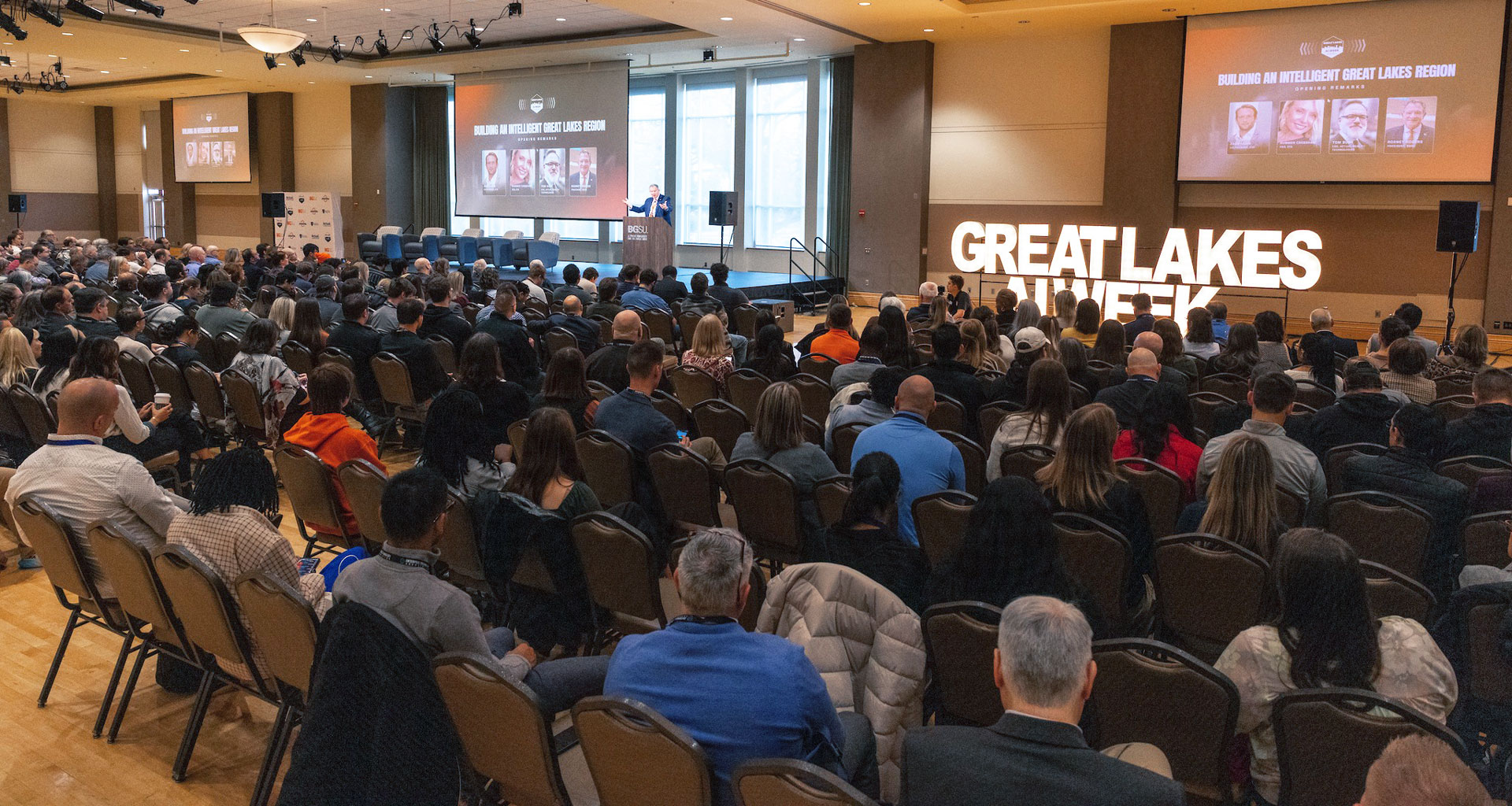
Recently, a large group from Hanson spent two days at Great Lakes AI Week, a regional conference hosted by Bowling Green State University where educators, technologists and business leaders gathered to explore practical, responsible and human-centered applications of AI.
Our team spanned designers, developers, strategists, project managers, operations and leadership, all arriving with similar questions: How do we use AI responsibly? How do we stay human-centered? And how do we turn all of this into meaningful value for our clients and our business?
AI that amplifies people, not replaces them
One theme surfaced again and again. AI isn’t here to take over. It’s here to elevate.
As several speakers put it, “AI won’t take your job, but somebody who knows how to use it will.” That line landed because it matches how we’ve been approaching this space—by leaning in instead of looking away.
Sessions on the future of work and AI agents challenged our team to pause and ask a key question: “Am I becoming more capable, or more dependent?” As Dave Rodriguez, Managing Director of Development, shared after a talk on AI agents, the real risk isn’t a “Terminator” scenario. It’s the quiet drift where we stop thinking for ourselves and let AI make decisions we used to own.
At Hanson, we’re choosing the “Star Trek path” instead, where AI handles the routine work so our people can focus on exploration, strategy and creativity.
Designing joyful, inclusive experiences with AI
Our UX and design teams gravitated toward sessions like Joyful Design in the Age of AI. The big takeaway? Joy is measurable, and we can intentionally design for it. Krista Boughner, Senior Designer, loved the idea of loading real user research into AI to build virtual personas. “I liked the idea of building a virtual user [where] you can ask pointed questions about UI/UX features, pain points and perspectives as a quick gut check.”
Others were inspired by tools like Lovable, an AI platform that can build app and website proofs of concept in minutes. For us, that’s not about replacing designers or developers. It’s about rapidly prototyping ideas so we can validate concepts sooner and refine what actually delivers value for users.
Accessibility was another powerful topic. After a session on AI-powered drive-through experiences at Wendy’s, IT Manager Aaron Essig walked away with a new perspective. What can sometimes feel like “just more AI” or a cost-cutting measure can actually create dignity and access for people with speech or reading challenges. As Director of Project Management, Susan Hanifan, put it, “Most of us don’t think of these everyday challenges, which means we risk missing an entire population when new products are developed.” This session helped showcase the unexpected places AI can show up and help solve distinctly “human” problems.
Working smarter: agents, automation and everyday workflows
Several of us were drawn to practical sessions on building AI into daily work. Voice-based interaction was a standout. Director of Experience Delivery Joe Holub has already been using voice to “brain-dump” ideas into AI while driving, and sessions like Thriving with AI reinforced how valuable that can be. Talking can move closer to the “speed of thought,” while typing forces us to self-edit too early. VP of People & Culture Mike Hirsh left committed to using AI’s “talk” features more intentionally to get into a better flow state and generate stronger first drafts.
Our developers and engineers dug into agents and small language models. From “trust but verify” approaches to AI-generated code to using multiple agents for planning, coding and debugging, the message was consistent. AI can accelerate the path from idea to prototype, but human judgment, testing and scrutiny are non-negotiable. We’re already using agents in a lot of our work, and we came back with several new things to experiment with so that our teams can spend more time on the strategic and fulfilling aspects of their roles.
Governance, transparency, and doing AI on purpose
Of course, exploring new tools is only half the story, as responsible adoption requires a thoughtful approach behind the scenes. If there was a single phrase that summed up the governance sessions, it came from Tom Bush’s talk titled Smart, Not Sneaky: “Good policy is the beginning of the trust cycle.” That resonated with our team. We don’t want AI usage hidden in the shadows; we want it out in the open, with clear guidelines, transparent tools and human beings clearly at the helm.
From risk and change-management sessions to talks on AI + ROI, we heard a consistent message that mirrors our own. Start with a real business problem, define the impact you’re aiming for, and then decide whether AI is the right tool. As Senior Project Manager Ashley Ramous noted, “You can’t just adopt AI to adopt AI. It’s not going to fix everything.”
What this means for our clients and our team
Great Lakes AI Week didn’t hand us a single playbook, and that’s a good thing. Instead, it reinforced the mindset we’re bringing to every engagement:
- Stay curious and keep learning.
- Design for humans first, then choose the right tools.
- Use AI to remove friction and elevate creativity, not replace it.
- Govern with transparency so trust can grow.
AI is changing fast. We’re choosing to change with empathy, critical thinking and our clients’ outcomes at the center of it all.